India–BLEU Trade Talks Put Ports and Air Connectivity on Cooperation Agenda
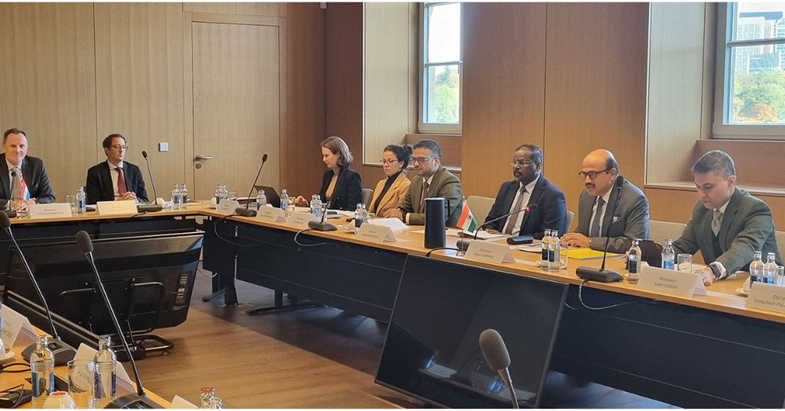
India–BLEU trade talks held in
Luxembourg on 29 October 2026 placed logistics, including ports and air
connectivity, among the sectors identified for deeper cooperation. The 19th Joint Economic Commission session
was co-chaired by India’s Commerce Secretary Rajesh Agrawal, Belgium’s Filip
Vanden Bulcke and Luxembourg’s Henri Schumacher. The participants reviewed trade and
investment relations and discussed market-access concerns. Other priorities
included renewable energy, financial services, digital technology, healthcare
and food processing. Following the
session, Agrawal met chief executives of Luxembourg-based companies and
encouraged long-term investment, technology partnerships and collaboration with
Indian businesses serving global value chains. BLEU refers to the Belgium–Luxembourg
Economic Union. Its joint commission with India provides an established
mechanism for discussing commercial and economic issues involving the three
countries. The Indian embassy
identifies the commission, established in 1997, as a principal forum for this
engagement. That institutional
setting allows discussions to cover both individual sectors and the conditions
affecting cross-border business. For logistics companies, market access,
investment arrangements and infrastructure cooperation can be closely
connected. A port or airport
partnership, for example, requires more than physical capacity. Commercial
participation depends on the services offered, operating arrangements and the
ability to connect infrastructure with customers and cargo. The Luxembourg meeting follows ministerial
engagement in India earlier this year.
On 7–8 September 2026, Luxembourg’s Deputy Prime Minister Xavier Bettel
and Economy Minister Lex Delles visited India for discussions covering
logistics, steel, finance, space and research. Bettel met External Affairs Minister S.
Jaishankar and Commerce and Industry Minister Piyush Goyal. Delles held
separate discussions on space cooperation and the decarbonisation of steel
production. The visit also included
engagement with businesses and research institutions in Chennai. These earlier meetings provide context for
the October commission session. They show logistics being considered alongside
finance, advanced industry and technology, rather than as an isolated transport
issue. For companies exploring
investment, those connections matter: industrial projects require supporting
infrastructure, access to capital and dependable supply chains before they can
serve international markets. A separate
agreement between Brussels Airport and Hyderabad International Airport
illustrates an existing avenue for logistics cooperation. Announced in September 2026, their
memorandum of understanding focuses on cargo development, knowledge sharing and
stronger links between Belgium and India.
The partnership brings together Brussels Airport’s
pharmaceutical-logistics expertise and Hyderabad’s life-sciences manufacturing
ecosystem. At the time of
announcement, no direct air connection operated between the airports. The
agreement established a framework to explore stronger connectivity and develop
commercial opportunities. Its
relevance to the wider economic dialogue lies in connecting transport
capabilities with a defined industry requirement. Pharmaceutical shipments
depend on specialised handling and reliable connections, making cooperation
between airports, manufacturers and logistics providers important. Port-related cooperation also has an
energy-transition dimension. Earlier
in 2026, Port of Antwerp-Bruges promoted engagement with Indian energy and
infrastructure stakeholders through a roadshow focused on future green-hydrogen
and green-ammonia trade corridors. That
initiative linked maritime infrastructure with the potential movement of
renewable fuels between India and Europe.
It provides background to the commission’s parallel interest in ports,
renewable energy and clean technology. Such trade requires coordination across
production, storage, transport and receiving infrastructure. The existence of discussions does not
itself establish a commercially operating corridor. Projects must still secure
customers, financing and the facilities needed to support regular movements. For shipping, aviation and logistics
businesses, the commission session identifies areas where government engagement
could support further commercial work.
The next step is translating those priorities into defined projects,
investment proposals and operating partnerships. The strongest opportunities are likely to
connect a clear customer requirement with appropriate infrastructure and
services. The recent airport partnership demonstrates one such approach, while
port and clean-energy discussions address longer-term possibilities.
The October meeting’s
immediate outcome is a renewed cooperation agenda. Its practical impact will
emerge through subsequent business engagement and projects that improve trade
connectivity between India, Belgium and Luxembourg.
Related News