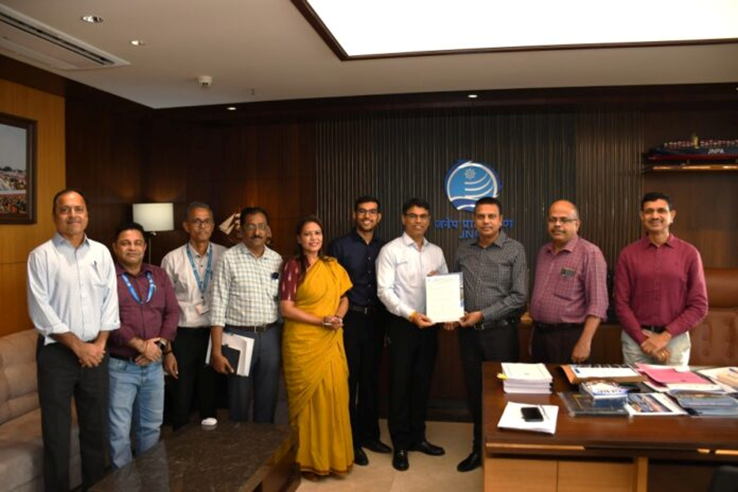
JNPA awards ₹76.92 crore shore power project at GTI Terminal – a major leap towards Green Shipping
The project marks
an important milestone in JNPA’s journey towards becoming a greener, cleaner
and more sustainable port, in line with the Government of India’s vision of
Green Ports, and the Ministry of Ports, Shipping and Waterways’ Harit Sagar
Green Port Guidelines. Shore Power
Supply, also known as Cold Ironing, is an advanced technology through which
vessels at berth receive electricity directly from the shore instead of operating
their onboard diesel-powered auxiliary generators. These generators normally
operate during the vessel’s stay at port to meet electricity requirements for
lighting, ventilation, refrigeration, pumps and other on-board systems. The project involves development of
dedicated electrical infrastructure, including 33 kV high-voltage distribution
systems, medium-voltage Static Frequency Converters (SFCs), 6.6 kV power
distribution, specialised power cables, shore-side connection equipment,
protection, control and monitoring systems, along with installation, testing
and commissioning. The frequency conversion system will ensure compatibility
between shore electricity and the electrical requirements of visiting vessels,
in accordance with applicable international standards, including IEC/IEEE
80005. The project is expected to
deliver substantial environmental benefits by enabling compatible vessels to
switch off their diesel-powered auxiliary generators while berthed. This will
help reduce greenhouse gas emissions, including carbon dioxide, as well as
nitrogen oxides, sulphur oxides and particulate matter. It will also reduce
noise and vibration from on-board generators, improving air quality and the
working environment within the port premises. The initiative will also provide
operational and economic benefits to shipping lines through reduced on-board
fuel consumption and auxiliary engine operating requirements, subject to
applicable shore electricity tariffs and vessel-specific consumption. The GTI Shore Power Project is part of
JNPA’s broader decarbonisation strategy. During FY 2025-26, JNPA achieved
approximately 60% renewable energy utilisation, with consumption of around 7.44
crore units of renewable electricity against total electricity consumption of
approximately 12.40 crore units, resulting in a reported carbon dioxide offset
of approximately 61,012 MT. The shore power initiative will further strengthen
the integration of clean energy with port operations. Speaking on the occasion, the Chairman,
JNPA, stated, “The award of the ₹76.92 crore Shore Power Supply Project at
GTI is a significant milestone in our commitment towards sustainable and
environmentally responsible port operations. By enabling visiting vessels to
utilise shorebased electricity instead of diesel-powered generators, JNPA is
taking concrete steps towards reducing emissions, improving air quality, and
promoting cleaner maritime operations. This project will serve as an important
foundation for extending shore power facilities to other terminals and
strengthening India’s green maritime ecosystem.” The GTI project represents the first
phase of JNPA’s planned shore power programme. JNPA is also pursuing the
development of shore power facilities at the balance container terminals
through appropriate project implementation models, including Public-Private
Partnership (PPP), to expand the benefits across the port. With this
initiative, JNPA reiterates its commitment to adopting globally recognised
green technologies and establishing itself as a leading sustainable maritime
gateway of India.
The Jawaharlal
Nehru Port Authority (JNPA) is one of India’s premier containerhandling ports
and a key gateway for the country’s EXIM trade. JNPA currently operates five
container terminals — NSFT, NSICT, NSIGT, BMCT and APMT. The port also has a
shallow water berth for general cargo, operated by NSDT. Its liquid cargo
facilities include a terminal managed by the BPCL-IOCL consortium and an
additional liquid cargo terminal developed by JNPA and operated by M/s JSW-JNPT
Liquid Terminal Pvt. Ltd. The port’s coastal berth further strengthens maritime
connectivity with other Indian ports and supports the growth of coastal cargo
and container movement. Spread across
277 hectares, JNPA also operates a strategically located multi-product Special
Economic Zone (SEZ) equipped with modern infrastructure and facilities to
support export-oriented industries and promote trade and investment. Looking
ahead, JNPA is developing the Vadhvan Port, an all-weather, deep-draft,
greenfield port in Maharashtra and the 13th Major Port of India.

Related News