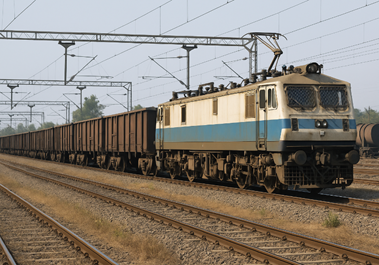
India Emerges as the World’s Second-Largest Rail Freight Carrier, Driven by Dedicated Freight Corridors
This achievement highlights the transformative impact
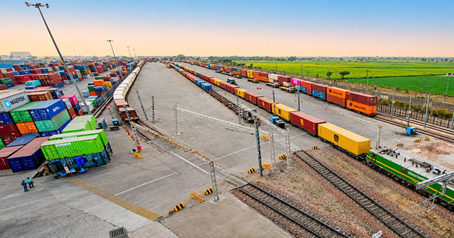
of India’s Dedicated Freight Corridors (DFCs), a network of high-capacity,
fully electrified lines built exclusively for freight movement. Currently
handling between 300 and 325 freight trains daily, the DFCs have dramatically
improved the speed, efficiency, and reliability of rail logistics across the
country.
The DFC network
spans over 2,800 km, comprising two main routes:
- Eastern Dedicated Freight Corridor (EDFC):
Ludhiana (Punjab) to Sonnagar (Bihar)
- Western Dedicated Freight Corridor (WDFC): JNPT Port (Mumbai) to Dadri (Uttar
Pradesh)
As of August 2025,
2,741 km of the network were operational, with full completion expected by
year-end. Freight trains on these corridors
run at average speeds of 50–60 km/h, more than twice the 20–25 km/h typical of
conventional mixed-traffic lines, a leap that has spurred a modal shift from
road to rail, especially for bulk and time-sensitive commodities like thermal
coal.
Between 2019 and 2025, Indian Railways’ freight
volumes rose from 1.22 to 1.61 billion tonnes, underscoring how the DFC
programme has strengthened industrial supply chains and supported India’s
manufacturing and export growth. Today, DFCs carry over 10% of the nation’s
total freight, easing passenger route congestion while improving supply chain
reliability.
Beyond logistics
efficiency, the DFCs are driving regional economic development, creating new
industrial clusters and logistics hubs along their routes. Their fully
electrified infrastructure aligns with India’s sustainability goals,
contributing to decarbonisation and the national target of net-zero emissions
by 2070.
Related News