
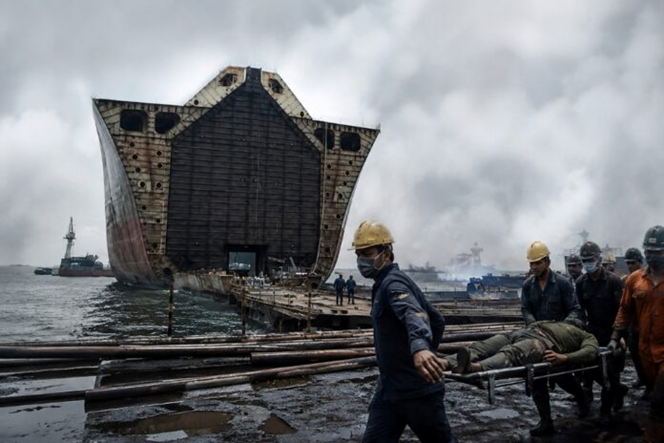
Nine workers killed in toxic gas leak at Sitakunda shipbreaking yard in Bangladesh
The incident happened around
9:00am inside an LNG-carrier MT Rasi,(IMO
9176008) at Ferdous Steel Shipyard on
the Station Road of Bhatiari. Among those killed was a 17-year-old. Several
other workers were injured.Firefighters rescued the workers from the vessel
which was anchored adjacent to Ferdous Steel Shipyard in the morning.The death
toll increased to nine after another injured worker, MotiurRahaman, 17, son of
MdHanif, of Sitakunda’sSonaichhari, died at a private hospital in
Chattogram.The other victims are Palash Das and Sunny Das — from Bhatiari;
Mohammad Khokon Mia, of Gaibandha; and Mohammad Mansur, Abdul AlimSujon, Md
Rana, Nasir Uddin and MdHanif — all fromSonaichari in Mirsarai.
Safety experts today (18 Aug) said the deaths were caused by an
accumulation of toxic gas inside a confined tank onboard the vessel. Fishermen
operating in the Bay of Bengal reported smelling the gas from half a kilometre
away.
Muhammad Ali Shahin, a shipbreaking expert and head of advocacy at the non-profit
organisation YPSA, described the incident as unprecedented. “I have never
seen such massive casualties in a shipbreaking yard,”Shahin said, pointing
to severe negligence by the yard authority.“Toxic gas had accumulated in the
ship’s tank,”Shahin explained. “Instead of slowly venting and cleaning
the tank with proper precautionary measures, the yard management sent workers
inside to extract the gas quickly.The workers opened the tank in a confined
space and inhaled the lethal fumes. Although this yard received Hong Kong
Convention (HKC) Green Yard certification, they failed to comply with its
safety guidelines.”
The incident comes despite the
Hong Kong International Convention for the Safe and Environmentally Sound
Recycling of Ships coming into force globally on June 26, 2025.Established by
the International Maritime Organization
(IMO), the treaty mandates strict guidelines, including an Inventory of
Hazardous Materials (IHM), regulator-approved Ship Recycling Plans (SRP), and
rigorous occupational health and safety protocols.“The technology and safety
protocols to reduce these risks exist, but the challenge is ensuring consistent
implementation rather than keeping them on paper,”Shahin added.The tragedy
occurred at a yard certified as compliant with the Hong Kong Convention (HKC). Only one month earlier, Bangladesh’s
Department of Inspection for Factories and Establishments had taken legal
action against Ferdous Steel following repeated occupational safety failures.
Following the deaths, the Bangladesh
Environmental Lawyers Association (BELA) issued a notice demanding an
independent investigation and the shutdown of the yard.
The scale of this tragedy is shocking, but fatal and serious accidents
in the sector are far from exceptional. According to The Daily Star, 84
accidents have occurred at Bangladeshi yards since the HKC entered into force
in June 2025, leaving 15 workers dead and 81 injured.These figures expose the gap between certification on paper and
conditions on the ground. They also underline the limits of the HKC itself. The
Convention establishes a weaker global baseline than the obligations of the
Basel Convention, which is designed to prevent hazardous waste from being
exported to countries unable to manage it in an environmentally sound manner.“Hazardous
end-of-life ships should not be exported for recycling where environmentally
sound management cannot be guaranteed. Yet, due to weak enforcement, vessels
continue to be sent to South Asian beaches despite recurring deaths, pollution,
and serious deficiencies in hazardous waste management. Certifications must not
become a licence to continue business as usual,” says IngvildJenssen, Executive Director of the NGO
Shipbreaking Platform.
Accountability does not stop at the yard gate. Shipowners and cash
buyers decide where vessels are dismantled and must bear responsibility for
those choices.
The RASI is the former HL RAS
LAFFAN, owned by South KoreanH-Line
Shipping and linked by shipping databases to cash buyer GMS. In March 2025,
the Platform specifically warned that H-Line was preparing to retire the
vessel, while denouncing the company’s continued disposal of end-of-life ships
on South Asian shores.The Platform calls on Bangladeshi authorities to ensure
an independent and transparent investigation into the nine deaths, hold those
responsible to account, schedule regular unannounced inspections, and enforce
safety and environmental requirements.The tragedy should also serve as yet
another warning to regulators elsewhere. As the European Commission considers
approving shipbreaking facilities that continue to dismantle vessels directly
on beaches, the costs of accepting certification in place of genuinely safe and
contained recycling infrastructure could not be clearer.
Related News