



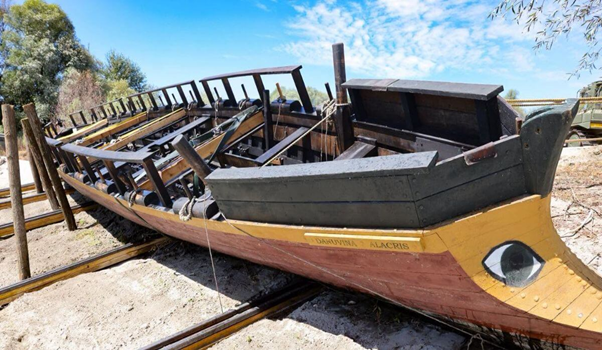
Croatian Army Rescues 18-Metre Ancient Roman Ship Replica Stranded by Low Water
The five-tonne wooden vessel, DanuvinaAlacris, is a replica of a Roman
galley built as part of a project involving Germany’s University of
Erlangen-Nuremberg. It was left at risk of serious damage after the low water
level prevented it from continuing its journey. The Croatian Army is now working to move
the ship back into the river. The operation is currently planned for Wednesday,
Aug. 26, depending on the arrival of special loading beams and towing equipment
organised by the German university.
Croatian Defence Minister Ivan Anušić visited the soldiers working on
the recovery. He had earlier approved assistance to the University of
Erlangen-Nuremberg after the Croatian Army was asked to help because of
concerns that the ship could collapse. He said the operation would help return
the vessel to Germany and described it as another example of cooperation
between Croatia and Germany. A total of 18 Croatian Army personnel are taking
part in the operation. Twelve are from the Engineering Battalion
of the Guards Armoured-Mechanised Brigade, while six are from the Engineering
Regiment. The engineers have prepared an access road to the ship and built
sliding “skis” to help move it towards the water. Wooden beams have also been
placed around the vessel to provide additional support because of concerns
about the stability of its structure.
Brigadier General Valentin Skroza, deputy commander of the Croatian Land
Forces, said the wooden vessel needed to be recovered quickly. He said that if
the operation had been delayed by another five days, the ship could have fallen apart. As the wood dries, cracks can form, which
could make the vessel no longer seaworthy.
The ship is therefore being continuously watered to
keep the wooden structure from drying out and to help prepare it for a return to
the water.
The Croatian Army is using an excavator, dozer, backhoe loader, cargo
vehicle, technical workshop, tugboat and two boats during the recovery. The Engineering Regiment has also delivered
a tugboat to the River Boat Company in Osijek. It will help tow the vessel
after it is relaunched. Skroza said Croatian Army engineers had the training
and equipment needed for the operation. He also noted that helping civilian
institutions is one of the roles of the Croatian Army.
German Military Envoy to Croatia Colonel Burkhard
Weber said the Croatian Army was the only force capable of carrying out such a
demanding task after Germany requested assistance.
He said Croatian Army personnel prepared the access
road quickly and used wooden beams to secure the vessel because of concerns
about its structure. Weber thanked
Anušić and Chief of the General Staff of the Croatian Armed Forces Lieutenant
General TihomirKundid for their quick response and for approving the necessary
measures to begin the operation. The recovery has been delayed because of
the complexity of the operation. Under the current plan, the University of
Erlangen-Nuremberg will arrange special loading beams and a tow train before
the planned Aug. 26 relaunch. After the ship is returned to the water, it will
be towed to the transit port of Osijek. The Osijek Port Authority is expected
to use a special loading crane to lift the vessel from the water and place it
on a transport vehicle known as the “swan” tow train. The vessel will then be transported back
to Germany.
The operation is also receiving support from Luka Tranzit Osijek and the
Osijek Port Authority. Anušić and Skroza thanked Luka Tranzit Osijek director
Igor Bartolović and Osijek Port Authority director Dr Iva Horvat for their
assistance.
Related News