



Ship recycling safety must start before the first cut
Ten workers lost their lives during a ship
recycling operation in Chattogram on August 14. Whatever the final findings, an
outcome of this scale is unacceptable. Statutory investigations will establish
the full circumstances. These observations arise from a preliminary technical
assessment and do not pre-empt those findings, but they point to a wider safety
issue. The maritime sector has strong controls for enclosed-space entry:
atmosphere testing, ventilation, controlled access and emergency arrangements.
The Chattogram accident raises a different question: what controls are required
before the space is opened at all?
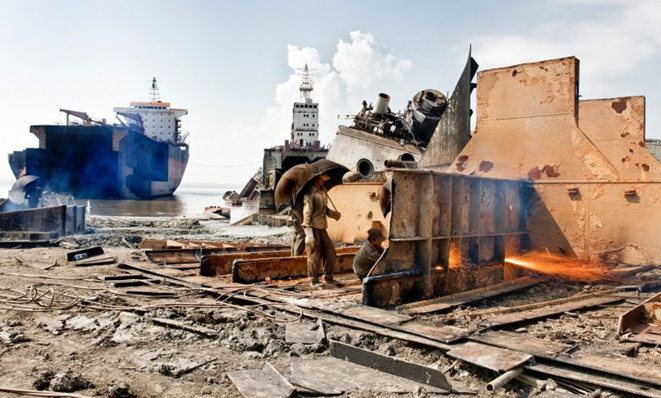
The workers involved in the initial exposure were in an open work area
when the bottom of double-bottom ballast tank No 3 on the port side was cut.
They were not undertaking a conventional confined-space entry. The hazard
originated in an enclosed space, but the exposure occurred outside it. That distinction is
not a defence. It should make us examine whether safety controls begin early
enough. Hydrogen sulphide is heavier
than air. If released suddenly from a low point, a dangerous cloud can form
close to ground level even in an open atmosphere. Being outside the tank
therefore does not necessarily mean natural ventilation will protect workers
from a large and rapid release. Our
preliminary assessment suggests prolonged biological activity inside a ballast
tank may have played an important role. Biofilm can develop and, where seawater
remains in a closed environment for a prolonged period, oxygen depletion can
create anoxic conditions. Temperature, pH changes and other conditions may
contribute to hydrogen sulphide formation.
A ballast tank is not necessarily a static environment. Conditions may
change significantly after a space remains closed for many additional
months. By the time of the accident, about 70% of the
vessel had been recycled. The engine room and accommodation had been
dismantled, and two other ballast tanks had previously been dealt with using
the same general method without the same outcome. That does not lessen the seriousness of the
accident or defend any participant. It illustrates a familiar safety problem:
repeated success can make a task feel routine even when the conditions behind
the next piece of steel are different. The successful opening of one ballast
tank cannot become the risk assessment for the next. The facility had been reviewed by recognised
organisations within the developing Hong Kong Convention framework.
Certification remains important, but it cannot replace a task-specific assessment
of conditions when work is carried out.
The technical classification of the event is important. It can be
described as an uncontrolled release of stored hazardous liquid and its
dissolved gas load from a residual enclosed space into an adjacent open work
area, during breaching of that space at its lowest point. This was a stored-energy event as much
as a toxic-atmosphere event. Current ship recycling safety architecture
is much clearer about controlling entry into an enclosed space than controlling
the first breach from outside. Yet opening a space can release its contents and
associated hazardous gas directly into the work area. The first opening of a previously sealed
ballast tank, void, cofferdam or similar space should therefore be treated as a
high-risk operation, regardless of whether anybody intends to enter it. The
safety system must control the breach as well as the entry. That means reassessing long-sealed spaces
before opening, considering how conditions may have changed, and ensuring
appropriate gas monitoring and exclusion arrangements are in place. Procedures alone are not enough. Workers,
supervisors and safety personnel need to understand that H2S risk is not
confined to someone physically entering a tank. A toxic atmosphere can develop
rapidly in an adjacent open work area, and smell must never be relied upon as
an indication that the area is safe.
The same principle applies to emergency response. In a toxic-gas
incident, the instinct to rush to a collapsed colleague can turn one casualty
into several within moments. Rescue cannot depend on improvisation.
Where required by the risk assessment, breathing apparatus must be immediately
available, trained personnel must be capable of responding and access to a suspected
gas-affected area must be controlled. Regular, realistic rescue drills should
test alarm raising, access control, response time and equipment readiness. Responsibility for specific failures must be
determined through the official process. But it would be a mistake to treat
this only as an issue concerning one yard, one vessel, one cash buyer, one
owner or one certification body. If a
routine operation can produce a hazard that existing risk assessments did not
sufficiently anticipate, the lesson belongs to the whole system. The maritime industry already understands
that entering an enclosed space demands strict controls. The lesson from this
accident is that those controls may need to begin one step earlier.
Even in an open work
area, the danger can come out of the tank.
Related News