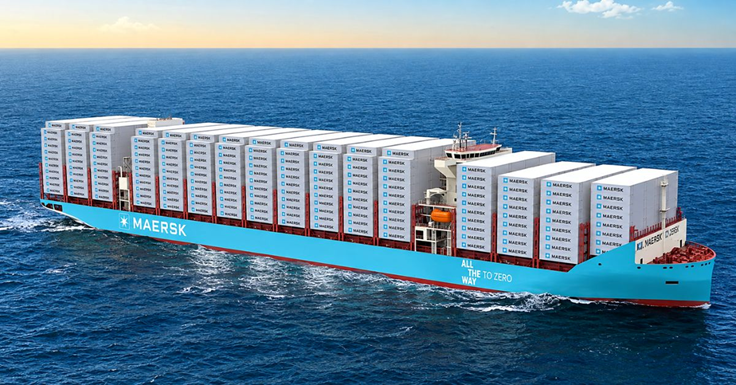
Maersk plans to order 42 new container ships in $8.9 billion fleet expansion, with Chinese shipyards set to dominate
Maersk has announced plans to
build 42 new liquefied natural gas (LNG) dual-fuel container ships, with the
order valued at an estimated $8.9 billion. All vessels will be large or
ultra-large container ships: 12 24,000-TEU ultra-large container ships, 24
19,000-TEU large container ships, and 6 18,600-TEU large container ships. Only one South Korean shipbuilder,
Hanwha Ocean, is participating in Maersk’s
planned order for 24,000-TEU ultra-large container ships, competing against
several Chinese shipyards for the contract. If finalized, these would be the
largest container ships Maersk has ever ordered. For the 24 large 19,000-TEU container ships,
negotiations are reportedly underway with Hengli Heavy Industries, which has
won Maersk’s favour by offering earlier delivery dates. The six 18,600-TEU
vessels are most likely optional orders currently held by New Times
Shipbuilding. In February 2026, Maersk signed a contract with New Times
Shipbuilding for 8+6 18,600 TEU container ships; if the six optional vessels
are confirmed, the total ships of this class under the partnership will rise to
14. New Times Shipbuilding has recently signed a main engine order with South
Korean engine manufacturer STX Engine for this batch of vessels. Based on currently available information,
this massive order from Maersk is highly likely to be entirely fulfilled by
Chinese shipyards, consistent with Maersk’s shipbuilding strategy in recent
years, having increasingly favoured Chinese shipyards since 2024.
The
broader trend of container ship orders flowing to Chinese shipyards is well
established. In the first half of 2026, global shipowners placed orders for 388
container ships in total, with Chinese shipyards securing over 80% of these
newbuild orders, while South Korean shipyards accounted for only 10-15%.
Shipowners’ preference for Chinese yards is largely tied to delivery schedules,
with Chinese shipyards able to deliver vessels earlier due to production
capacity advantages, while South Korean yards face capacity constraints when
constructing multiple vessel types simultaneously. Chinese shipyards’ ongoing
refinement of dual-fuel container ship technology has also been a key factor
attracting orders.
Maersk’s high-profile order
marks a shift in the carrier’s decade-long logistics integration strategy. The
company’s original approach focused on diversifying logistics operations to
reduce exposure to volatile freight markets, but as global supply chains
rapidly evolved, Maersk has refocused on its core ocean shipping business,
having found that its land and air logistics divisions failed to offset ocean
freight volatility as expected, while bloated organisational structures and
infrastructure maintenance costs became a burden. Under its previous integrated logistics
strategy, even during the pandemic shipping boom, Maersk maintained a
conservative fleet size of between 4 million and 4.4 million TEU, limiting new
orders largely to replacing ageing vessels. As of now, Maersk’s fleet consists
of 752 container ships with a total capacity of nearly 4.75 million TEU, with
years of capacity restraint pushing the existing fleet to its limits, prompting
the carrier to abandon its fleet size cap in favour of aggressive
expansion. The overhaul is also driven by
competitive pressure. In early 2022, MSC surpassed Maersk to become the world’s
largest container shipping company, with both carriers then controlling
slightly over 4.2 million TEU each. After four years of expansion, MSC’s
capacity has reached nearly 7.4 million TEU, widening the gap with Maersk to
approximately 2.7 million TEU. Meanwhile, CMA CGM, the world’s third-largest
carrier, has said it will surpass Maersk by 2027 to become the world’s
second-largest player, backed by an order book of approximately 1.7 million TEU
compared to Maersk’s roughly 1.2 million TEU, and a current fleet gap of just
350,000 TEU. Facing pressure both internally and from rivals, Maersk has abandoned
its previously conservative shipbuilding approach, announcing in a single move
that it will order 42 large and ultra-large container ships.
Related News