China’s non-tariff walls a major export hurdle: FM Nirmala Sitharaman
She also called
for a review of India’s trade agreement with the Association
of Southeast Asian Nations (Asean), saying its benefits were skewed in favour
of the bloc. “A decade has gone by
consistently putting up a case for market access for Indian products but
non-tariff barriers have been very strong and China uses non-tariff barriers
unhesitatingly. Non-tariff barriers are the biggest hurdle in the trade between
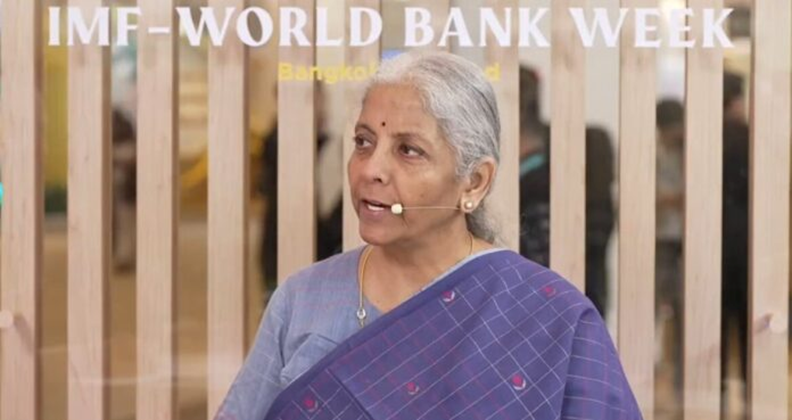
India and China,” she said during a conversation hosted by the Atlantic Council on the sidelines of
the International Monetary Fund-World
Bank annual meetings in Bangkok.
India’s trade deficit with China more than doubled to $112 billion in
FY26 from $52.7 billion in FY16. Sitharaman said New Delhi had repeatedly
sought market access for products in which India had a competitive advantage,
but progress had been limited despite scope for discussions on sanitary and
phytosanitary measures and other regulatory issues. Responding to Sitharaman’s remarks,
China’s foreign ministry said Beijing was ready to work with New Delhi to
address “each other’s economic and trade concerns in a balanced way and promote
the steady development of bilateral relations”. “China never aims for trade
surplus,” Chinese foreign ministry Spokesperson Mao Ning told media in
Beijing, as reported by PTI.
Sitharaman’s comments come days after Commerce Minister Shri PiyushGoyal said India was working to
develop relations with China “once again”, while cautioning that the outcome
remained uncertain.
“I think we had some concerns
in the past. We are working to develop relations with China once again, but the
last word has not been scripted on this journey,” he said on Wednesday at the
Bloomberg New Economy Forum.
Sitharaman said India had refrained from adopting punitive trade
measures to address its trade imbalance with China, preferring negotiations
despite the difficulties involved, unlike some other countries. “Probably
that’s not the way India believes in dealing with trade negotiations. We sit
and talk. It is sometimes very tiresome but we do go through that approach
rather than putting countervailing duties or some non-tariff barriers to
counter their non-tariff barriers,” she said. On the skew in trade benefits in favour of
Asean, Sitharaman said India needed to reassess the impact of its trade
agreement with the bloc, signed more than a decade ago, and refashion it to
address the imbalance and its effects on domestic manufacturers and importers.
“We need to have that agreement continue but in a slightly refashioned manner.
It cannot so adversely affect one side which is the Indian side,” she said.
India’s trade deficit with Asean countries crossed $50 billion in FY26. Sitharaman also defended India’s decision
to stay out of the Regional Comprehensive Economic Partnership (RCEP), saying
the government had not seen sufficient benefits in joining the trade framework.
“We took a conscious call to stay out of RCEP because we didn’t think it was
going to do any help for us,” she said.
Sitharaman said Indian exporters had turned global trade disruptions
into opportunities by identifying alternative markets, including countries that
had imposed high tariffs on Indian goods. Exports of goods and services grew 23
per cent in September, she said, citing the performance as evidence of
exporters’ resilience amid a difficult global environment. “Even in this situation Indian exporters
have found very many different alternative markets — and even to markets which
have literally levied huge tariffs on us — we have reached these markets and
very efficiently,” she said.
India remained committed to multilateralism but was accelerating
bilateral trade agreements rather than waiting for progress in the global
trading system, the minister said. “We believe in multilateralism. However,
given today’s environment we are very keen that we build our strength in trade
through bilateral agreements as well.”
She cited India’s trade engagements with the European Union, New
Zealand, Australia and the United Arab Emirates, as well as negotiations with
Canada, saying political will on both sides had helped move long-pending talks
forward.
On India-US tradenegotiations, following recent
comments by Goyal, Sitharamansaid: “I hope in the interest of global trade and in the
interest of trade between the two partners India and US the trade agreement
gets concluded at the earliest.”
Related News