


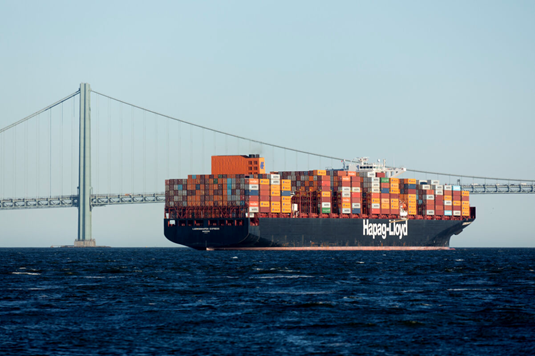
Gemini shifts AE19 service back through Suez
The change begins with Berlin Maersk on
westbound voyage 628W and eastbound voyage 637E. Maersk said the decision
followed an assessment of the security situation in the Red Sea and represents
a further step towards a gradual return to the trans-Suez corridor. AE19 connects Asia, the Mediterranean, Saudi
Arabia and Europe. Under the revised routing, the service will call Xingang,
Qingdao, Busan, Ningbo, Shanghai, TanjungPelepas and Jeddah before transiting
the Suez Canal to Port Said and Port Tangier. The return leg will again pass
through Port Said, the Suez Canal and Jeddah before Singapore and Xingang. Maersk said moving the service through
Suez rather than around the Cape of Good Hope will provide more efficient
transit times. However, the carrier stressed that the structural change is
limited to AE19 at this stage. The
company said there are currently no plans to change other Gemini services and
no specific timetable for a broader return of its East-West network to the Suez
corridor. It also said the partners are not yet considering a full East-West
network shift back to trans-Suez routing.
The move builds on
earlier steps taken by the Gemini partners. In February 2026, Hapag-Lloyd and
Maersk announced that the IMX service connecting India and the Middle East with
the Mediterranean would begin
using the Red Sea and Suez Canal, with naval assistance planned for the passage.
At that stage,
Hapag-Lloyd said two further Gemini services, SE1 and SE3, could also return
through the Red Sea when operationally feasible and when minimum security
requirements were met. The partners did not announce changes to the remainder
of the Gemini network.
Gemini Cooperation began operations in February
2025. Its initial network was structured around Cape of Good Hope routings
because of the security situation in the Red Sea. Hapag-Lloyd has previously
said the cooperation intended to return to a Suez-based East-West network when
security conditions allowed.
Related News