


Singapore and Brazil Sign MOU to Launch Green and Digital Shipping Corridor
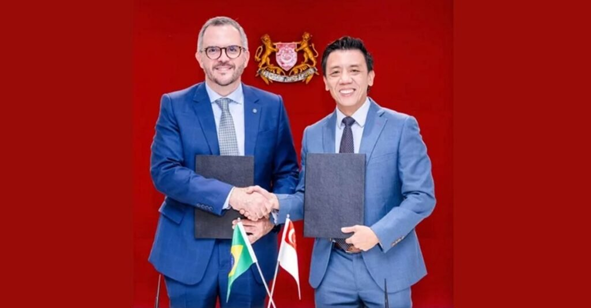
Singapore and Brazil have signed a Memorandum of
Understanding (MOU) to establish the Singapore-Brazil Green and Digital
Shipping Corridor (GDSC), marking a new chapter in bilateral maritime
cooperation between the two countries. The agreement was signed by Singapore’s
Minister for Transport, Jeffrey Siow, and Brazil’s Minister of Ports and
Airports, Tomé Franca, and was published by the Maritime and Port Authority of
Singapore (MPA) on 28 August 2026.
The corridor is designed to strengthen cooperation
between the two nations on maritime decarbonisation and digitalisation, while
supporting the broader shift toward more sustainable and efficient
international shipping.
At the heart of the partnership is a complementary pairing of strengths.
Brazil holds significant renewable energy resources and production capabilities
that position it as a potential supplier of zero and near-zero greenhouse gas
emission marine fuels. Singapore, meanwhile, is the world’s largest bunkering
port and a leading global hub port backed by a vibrant maritime innovation
ecosystem. Under the GDSC, the two
countries intend to bring these strengths together to support the development
of alternative marine fuel supply chains, an area that has become central to
the global shipping industry’s decarbonisation push as the International
Maritime Organization’s emissions targets draw closer. Beyond fuel supply chains, the MOU also
opens the door to digital collaboration. Singapore and Brazil will explore
digital information exchanges aimed at improving maritime and port operations,
and will work with industry stakeholders to advance the research, development,
and adoption of emerging maritime technologies and solutions. Green shipping corridors have emerged as one
of the maritime industry’s key mechanisms for de-risking the transition to
alternative fuels, by linking specific trade routes and port pairs with
coordinated investment in fuel production, bunkering infrastructure, and
regulatory alignment. Singapore has been steadily building out a network of
such corridors with partner nations as part of its broader Maritime Singapore
Decarbonisation Blueprint, positioning the port as a preferred bunkering and
refuelling hub for future marine fuels.
Brazil’s entry into this network is notable given the country’s
renewable energy base, including biofuels, green hydrogen, and ammonia
production potential, all of which are seen as viable feedstocks for the next
generation of marine fuels. For Singapore, the corridor offers a pathway to
secure future fuel supply from a major renewable energy producer, while for
Brazil it opens access to one of the world’s busiest and most technologically
advanced ports. The MOU does not
specify a timeline for implementation or detail specific fuel volumes, infrastructure
investments, or pilot voyages, but signals a formal commitment from both
governments to jointly explore the corridor’s development going forward. The Singapore-Brazil agreement adds to a
growing list of green and digital shipping corridor partnerships Singapore has
signed with countries around the world in recent years, reflecting the
city-state’s ambition to remain at the centre of global efforts to decarbonise
shipping while maintaining its position as a leading transshipment and
bunkering hub. For the shipping
industry, the corridor is another signal that alternative marine fuel supply
chains are moving from pilot-stage discussions toward structured,
government-backed frameworks, even as questions remain around cost,
scalability, and the pace of vessel retrofitting needed to make these fuels
commercially viable at scale.
Related News