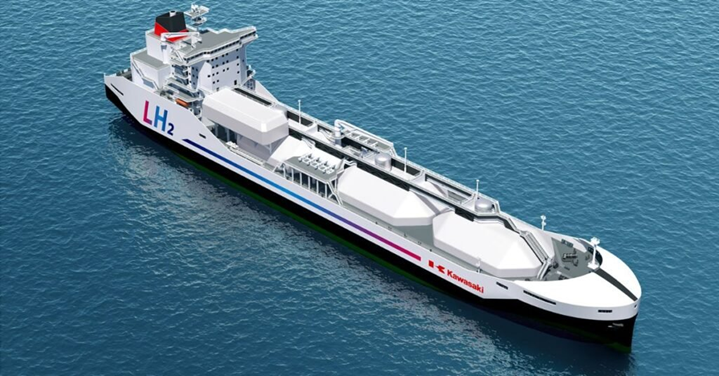
Yokogawa wins KHI orders for automation systems for large liquefied hydrogen carrier
The 40,000-cu-metre carrier is being developed as the world’s largest
vessel of its type. Yokogawa’s automation system will provide integrated
monitoring and control of onboard equipment, together with emergency shutdown
functions, to support the handling and transportation of liquefied hydrogen at
extremely low temperatures. The system
is also designed to improve equipment performance and reduce crew workload
through integrated control capabilities over the vessel’s lifecycle. Yokogawa will also supply integrated
automation systems for marine hydrogen fuel systems (MHFS) on the two
hydrogen-fuelled vessels.
An MHFS comprises liquefied hydrogen storage tanks
and fuel supply equipment. The system integrates control, monitoring and safety
functions and is intended to support the use of hydrogen as a marine fuel.
The vessels are being built under a Green Innovation Fund project led by
Japan’s New Energy and Industrial Technology Development Organization (NEDO).
The project is aimed at enabling safe, large-scale maritime transportation of
liquefied hydrogen and supporting development of the associated supply chain.
Koji Nakaoka, Executive Vice President & Executive Officer and head
of the Energy & Sustainability Business Headquarters at Yokogawa Electric,
said Yokogawa has extensive experience with liquefied natural gas carriers, and
that its technology is also being applied to liquefied hydrogen carriers. He
said the company will continue to leverage the technologies and expertise it
has developed in control and safety instrumentation to provide solutions
supporting the industry’s shift toward hydrogen-based maritime transport.
Related News