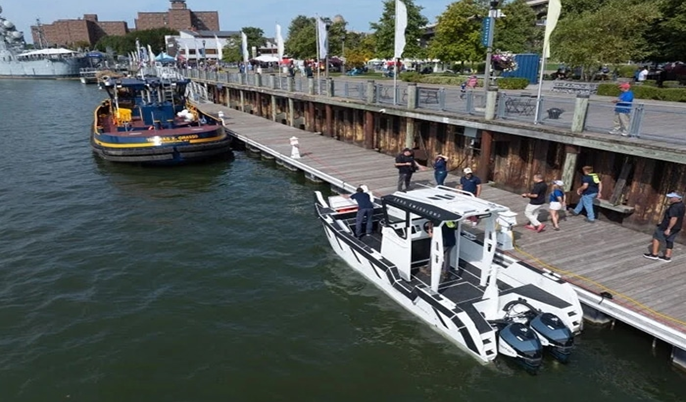
Photon Marine wins $1M Megaboost Award for Erie Canal marine electrification project
The NSF Energy
Storage Engine in Upstate New York has selected Portland,
Oregon-based electric marine innovator Photon Marine to receive its
inaugural $1 million MegaBoost award. It will put a production-grade electric
workboat, a marine fast charger and a first-of-its-kind floating energy storage
platform into service in New York State.
It follows a pilot in which a small leased workboat, fitted with
electric outboards from Photon Marine has been quietly doing ordinary things on
the New York State Canal System, including pulling buoys, towing dredge pipe
and carrying crews out to job sites. All without burning fuel. That boat, a leased hull fitted with
electric outboards from Photon Marine, was a pilot project with the New York
Power Authority and the New York State Canal Corporation. The crews wanted to
know something practical. Not whether an electric workboat could exist, but
whether it could get through a Tuesday. (29 Sep) The NSF Energy Storage Engine says that the
next chapter is considerably more ambitious.
Building on real-world operating experience from the pilot, Photon
Marine will develop something American waterways have not yet had: a complete
marine electrification ecosystem, with the boat, the charger and the energy
storage all designed to work together.
The first piece of the ecosystem is the vessel: A 24-foot workboat
equipped with Photon Marine’s Gen-7 P300 electric propulsion system, which delivers
up to 300 peak horsepower. The second
piece is a 40-kilowatt marine DC fast charger, designed to support commercial,
government and recreational vessels using New York’s waterways. “This sounds mundane,” says the NSF Energy
Storage Engine, but “it is arguably the most important part of the project. A
boat without a charger is a boat with a deadline.” The third piece of the ecosystem is the
ChargeBarge: a 32-foot floating platform carrying battery energy storage and
high-power charging equipment. Instead of requiring every dock and lock and
boat launch to be wired for fast charging, the ChargeBarge moves the energy to
wherever the work is happening. It is
designed to charge vessels directly, support fleets working far from shore
power, serve temporary events, and potentially supply power during grid
disruptions. It will be fabricated in New York State by Derecktor
Shipyards.
“Commercial marine electrification will only scale when operators can
see that the technology works in the conditions they face every day,” said
Marcelino J. Alvarez, co-founder and CEO of Photon Marine. “This project gives
us the opportunity to demonstrate an entire electrification ecosystem, from the
propulsion system to the charger to mobile energy storage, while building on
the real-world operating experience we have developed with NYPA. Just as
importantly, we are doing it on one of America’s most iconic waterways and
working with New York partners to create a model that can ultimately be
replicated far beyond the Erie Canal, from international sailing races to
Caribbean fishing fleets to dual-use and autonomous applications.”
Related News