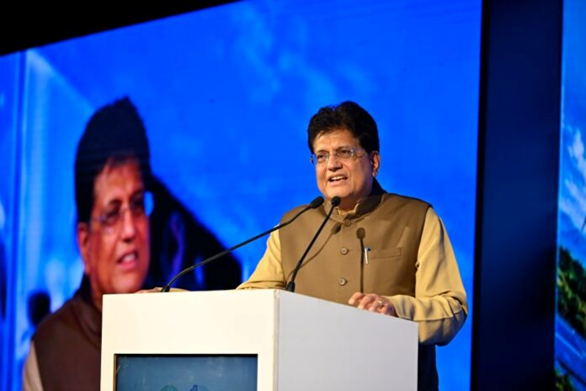
Piyush Goyal calls for Greater FTA utilisation by Telangana
Shri Goyal said
India’s existing trade agreements had provided preferential market access to a
global GDP of $70 trillion, including $10 trillion through agreements finalised
more than a decade ago and an additional $60 trillion through the nine recently
finalised agreements. With negotiations underway for another eight bilateral or
multilateral agreements, which he said would add a further $15 trillion, India
would have preferential market access covering approximately 76 per cent of the
global GDP of $115 trillion. He noted
that the IMF had projected global trade growth of barely 1.9 per cent amid
global challenges. Against this backdrop, India set a target of $1 trillion in
exports, aiming for 15 per cent growth in the current year. He said the target
reflected the collective conviction of exporters, industry associations and
businesses to surpass conventional forecasts. Highlighting India’s economic performance,
Shri Goyal said the country had moved from the “Fragile Five” a decade ago to
the world’s fifth-largest economy and the fastest-growing large economy. He
cited growth of 7.7 per cent in the previous year and 7.8 per cent in the first
quarter of the current year, expressing the expectation that growth would
remain above 7 per cent in the quarter ending September. He also referred to
the IMF’s recent assessment of stronger-than-expected economic performance and
its expectation that India would continue to be the fastest-growing large
economy in the current and following year.
The Minister acknowledged global uncertainties arising from conflicts in
West Asia and Ukraine and disruptions around the Strait of Hormuz. He said
India continued to demonstrate resilience amid these challenges and highlighted
upgrades to India’s credit rating by multiple international rating agencies,
including the Japanese Credit Rating Agency (JCR), which upgraded India’s
rating for the first time in over 35 years.
The Minister said India offered investors stable policies, open borders,
supply chain resilience and the assurance that the rule of law would protect
their interests. He highlighted that, over the preceding four and a half years,
India had negotiated and finalised nine free trade agreements or bilateral
trade agreements, opening opportunities for Indian businesses in 38 developed
countries. He said these countries offered complementary capabilities,
including advanced equipment, modern technologies, high-tech devices and
graphics processing units (GPUs) required by Indian industry. Referring to Telangana’s historical
trading traditions, Shri Goyal recalled the Motupalli Abhaya Shasana, a
maritime charter issued in 1244 by Kakatiya ruler, Ganapati Deva, which
promoted stability and predictability in trade. He drew parallels with the
present, noting that investors continue to seek certainty and continuity in
policy. Emphasising the collective
responsibility towards Viksit Bharat 2047, Shri Goyal said the country’s
journey towards shared prosperity required the collective drive and energy of
1.4 billion Indians. He said the commitment and capabilities of Telangana’s
skilled, qualified and youthful population could help the State set new
benchmarks for growth and development.
Referring to Telangana’s aspiration to grow from an economy of
approximately $200 billion to $3 trillion by 2047, he welcomed the target set
by the state government. “Impossible
doesn’t exist in my dictionary,” Shri Goyal said, acknowledging that achieving
the target would require considerable collective effort. He said the Central
Government, State Government, businesses, investors, farmers, fishermen,
technical manpower, scientists, innovators, startups, women entrepreneurs and
officials would all have to contribute to the State’s development. Shri Goyal said Telangana is well
positioned to contribute to the Viksit Bharat vision through its pharmaceutical
industry, aerospace and defence capabilities, value-added agriculture, food
processing, research and development, innovation and services sector. He also
highlighted the opportunities presented by global capability centres, design
and innovation, and the State’s talent in artificial intelligence and quantum
computing. Emphasising that every
contribution mattered to economic development, the Minister referred to the
dispatch of 2.5 metric tonnes of GI-tagged Tandur red gram from Hyderabad to
Australia, leveraging the India-Australia free trade agreement. He said such
exports demonstrated how trade agreements could create opportunities not only
for large industries but also for farmers and smaller producers. Shri Goyal emphasised that every
contribution, big or small, was important to India’s development journey. He
highlighted the role of farmers, entrepreneurs, MSMEs and other stakeholders in
collectively advancing the vision of Viksit Bharat 2047. The Minister reiterated the Central
Government’s commitment to Telangana’s development and referred to projects
launched or supported in the State. He mentioned the foundation stone for the
Zaheerabad Industrial Smart City, which he said would provide plug-and-play
industrial land for automobiles, food processing, machinery and electrical
equipment. He also referred to the Kakatiya Mega Textile Park in Warangal,
describing it as the first fully functional PM MITRA park, and highlighted its
alignment with the 5F vision of “farm to fibre, fibre to factory, factory to
fashion, and fashion to foreign”.
Calling for closer coordination between the Centre and the States, Shri
Goyal said Telangana’s development vision for 2047 was aligned with the national
vision of Viksit Bharat articulated by Prime Minister, Shri Narendra Modi. Outlining six suggestions for the way
forward, Shri Goyal proposed that Telangana identify its 50 leading export
products across goods and services and map markets offering preferential access
under existing FTAs. He also suggested setting up FTA help desks in every
district to help MSMEs, farmers and startups make the most of these
agreements. He called for taking
GI-tagged products such as Tandur red gram, Chatpata chilli and Nizamabad
turmeric to global markets, stressing the need for traceability, packaging and
branding to help farmers secure a premium for their produce. Shri Goyal suggested moving Telangana’s
pharmaceutical industry up the value chain by strengthening domestic
capabilities in key starting materials and active pharmaceutical ingredients
(APIs), investing in innovation, and moving beyond generics towards high-value
branded and innovative pharmaceutical products, biosimilars and biotechnology. Identifying opportunities in space, aerospace,
aircraft components, maintenance, repair and overhaul (MRO), defence,
electronics, artificial intelligence, quantum computing and machine learning,
he called for developing precision engineering and tooling capabilities,
establishing advanced testing facilities and partnering with leading global
institutions in science, technology and manufacturing. He also proposed stronger linkages between
industry, academia and government to advance research and development and
skilling, helping prepare the workforce for future industrial and technological
requirements. Finally, Shri Goyal
suggested accelerating ease-of-doing-business reforms through the
decriminalisation of minor offences, reduced compliance burdens, simplified
procedures and time-bound single-window clearances. Referring to the Centre’s
efforts in this direction, he encouraged Telangana to consider similar measures
to simplify business operations and citizens’ lives, thereby strengthening ease
of living across the State.
Concluding his
address, Shri Goyal invoked the symbolism of Diwali, saying that light spreads
one diya at a time. He said every investment, export, new job and startup would
bring Telangana and the whole nation closer to the shared vision of a developed
and prosperous nation by 2047. Inviting investors from India and across the
world to explore Telangana’s opportunities, he called for enduring partnerships
that generate employment and contribute to the prosperity of the people of
Telangana and India.
Related News