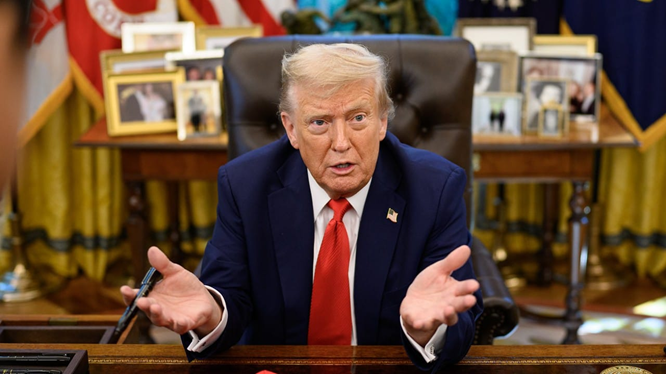
How will the ‘blue tsunami’ impact Trump administration policies?
In what has been described as a “blue
tsunami” Democrats have stormed back into Congress taking control of the
country’s finances, after the electorate reportedly chose to “Punish Trump”
with the unpopular Iran War a major factor.
So where will this leave the administration’s policies across a range of
areas related to maritime including the war in Iran and the Strait of Hormuz,
energy markets, and policies related to sanctions and decarbonisation. Donald Trump has admitted it is “largely
true” that the war in Iran was behind the Republican mid-term losses while Vice
President JD Vance has stated it was “the reason we lost.” Prior to the
midterms a build of US military assets in the Middle East had pointed to
further attacks on Iran but analysts believe the price of such a move has now
increased. Rystad Energy’s Chief
Economist, Claudio Galimberti, explained that: “A Democratic sweep changes the
political cost of continuing the Iran war. The White House keeps its
discretionary powers over strikes, blockades and sanctions licenses. What
changes, however, is the price of using them. With both chambers now capable of
passing resolutions, holding back war funding and delaying confirmations, the
administration faces a shorter political runway and greater institutional
pressure to find a Hormuz deal. That is relevant for oil markets because a
restoration of flows through the strait is what is ultimately needed for crude
supply and product inventories to normalize.” Rystad highlights that President Trump, as
Commander in Chief, can still direct military actions, with absolute
Congressional over-rides highly unlikely, but with House and Senate able to
apply pressure in different ways.
They explain: “What a unified Democratic Congress can do is make
escalation considerably more costly: both chambers can pass resolutions, attach
conditions to war spending and hold back confirmations of key officials. With
war funding and appointees now subject to a hostile majority, the
administration faces greater institutional pressure to pursue a Hormuz deal
rather than a further round of strikes.”
Rystad adds that: “A restoration of flows through the Strait of Hormuz
is the prerequisite for Middle East crude supply and refined product
inventories to normalize.” Other
shipping analysts tried to assess the impact on policy making by the
administration in the coming two years.
Analyst Darron Wadey asked: “As the Administration essentially sets
executive branch policy, it can still pursue its desired paths, with that in
mind, a lot will depend upon how the current administration reacts: will it
continue as it has for the last two years, or compromise?” The Dynamar analyst pointed out that
Barack Obama was in a similar situation, with an all-Republican Congress,
following the midterm elections in his second presidency, and was still able to
follow his policy agenda using executive orders, agency rulemaking and other
discretionary powers. “The challenge
comes when major legislation or appropriations (finance) are needed to pursue
policy. These are wholly dependent upon Congress” said Wadey. Trump’s recently agreed deal to buy
Russian diesel in an attempt to ease cost of living tensions, is under
immediate threat here, according to Wadey, who pointed out that the acquisition
of Russian diesel had already come under fire, even with a friendly
Congress. “Figures within the
executive and legislative branches are at odds over the legality of such a
move,” said Wadey, “One advises that such imports are legal, the others point
to the Ending Importation of Russian Oil Act of 2022, says otherwise.” Meanwhile, Lookout Maritime founder Martin
Crawford-Brunt called the importation of Russian diesel “A PR stunt” with
“miniscule volumes”, of about 45,000 tonnes, which, “The smart money says will
end up in South America”. Speaking to
Seatrade Maritime News having just landed in the UK, having travelled from the
US overnight, Crawford-Brunt, pointed out that most of the companies involved
in the logistics of delivering this fuel are listed companies, “They would have
to be brave or stupid,” to bring them to the US. Crawford-Brunt pointed out that US
legislation has sanctioned Russian oil products and that would leave any
company importing it to the US open to criminal charges. “You can’t dip in and out of sanctions,”
said Crawford-Brunt, who added, “Who would take the reputational risk for one
cargo? You’d be nuts to take it”.
Turning to the US’ stance on the International Maritime Organization’s
(IMO) Net Zero Framework Crawford-Brunt suggested that Trump may be unwilling
to return to last year’s tactics of threatening nations, but he said, “Anything
that increases costs will be difficult to pass, it’s just not palatable right
now.” Environmental voices from
within the US do not share that view. Jamie Yates, climate and renewable energy
manager at Pacific Environment, said: “US voters are rejecting backward energy policies
that drove up household costs and undoubtedly accelerated the effects of
climate disasters.” Pacific
Environment believe the Trump administration has attempted to frustrate the
IMO’s ambition at every turn.
Yates urged IMO member states, “To reject
delay tactics and formally adopt the Net-Zero Framework. The world has already
lost a year in climate action from shipping; it cannot afford another.”

Related News