



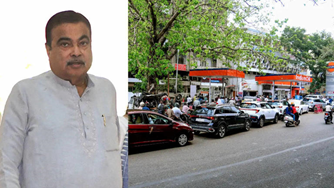
Vehicle owners say that blending of petrol with ethanol may impact their vehicles' engines or impact mileage
e20 impact mileage
nitin gadkari says 2 6 per cent petroleum ministry gives different figure
Amid nationwide
concerns over blending of petrol with ethanol — 80 per cent petrol and 20 per cent ethanol
— shown by vehicle owners that it may impact their vehicles' engines or impact
mileage, Union Minister for Road Transport and Highways, Nitin Gadkari informed
the Parliament on Friday that the use of E20 may impact fuel economy by 2-6 per
cent depending upon the vehicle category and vintage. While the Union Minister said that there
could be a drop of 2-6 per cent in fuel economy, a few days ago, the Petroleum
ministry had said that the use of E20-powered petrol may impact 3-5 per cent on
a vehicles' mileage. The Petroleum ministry comes under Union Minister Hardeep
Singh Puri. However, the Union Minister Gadkari informed that engine durability
tests on a dynamometer and on-road vehicle tests have not shown any failures
over the use of blending petrol.
In fact, Gadkari said that E20
fuel provides better accelerations, improved ride
quality, and around 30 per cent lower carbon emissions compared to E10.
In a written reply in Lok Sabha, as the monsoon session is underway,
Gadkari informed that a study had been conducted to evaluate the effect of E20
on BS-III, BS-IV, and BS-VI E10 (gasoline) two-wheelers and four-wheelers. The
study was carried out jointly by ARAI, SIAM, and Indian Oil Corporation Ltd
(IOCL).
The study comprised standard
testing as per the respective certification requirements and customized test
protocols developed along with the Original Equipment Manufacturers (OEMs). "The fuel efficiency of vehicles may
be reduced by 2 to 6 per cent depending on the vehicle category and vintage.
The tests for engine durability on a dynamometer and vehicle tests on the road
have not shown any failures due to E20," the minister said.
The rollout of E20
petrol — 80 per cent petrol, 20 per cent ethanol — has drawn criticism from
opposition parties and some consumer groups, who have raised concerns about its
impact on older vehicles not specifically designed for 20 per cent ethanol
blends.
Critics have questioned whether all vehicles are fully compatible with
E20, flagged the possibility of reduced fuel efficiency and higher maintenance
costs, and sought clarity on liability if engine or fuel-system problems arise.
The government has maintained that the transition has been phased and
backed by extensive testing, while automobile manufacturers have said they
continue to honour warranty claims for vehicles using E20 fuel.
Opposition parties
have repeatedly sought greater transparency on vehicle compatibility and
consumer safeguards.
The minister explained
that the Ethanol blended petrol (EBP) programme has been implemented through a
phased, scientifically validated, and consultative process involving NITI
Aayog, automobile manufacturers, Oil Marketing Companies (OMCs), Automotive
Research Association of India (ARAI), Society of Indian Automobile
Manufacturers (SIAM), Indian Institute of Petroleum (IIP), and other technical
institutions. In India, he said the
ethanol blended petrol (EBP) programme commenced with a pilot in 2001, E5 was
introduced in 2006, and although blending remained around 1.53 per cent in
2013-14, it has since been increased progressively in a calibrated manner after
creating the necessary production capacity, infrastructure, and regulatory
framework.
According to him, E15+
blended petrol has been in widespread use for over three-and-a-half years, and
E19-E20 fuel for over two-and-a-half years.
Gadkari noted that more than 20 crore two-wheelers and over 3 crore
petrol cars have been operating on these blends without any verified evidence
of widespread engine failure or vehicle breakdown attributable to ethanol
blending. "Manufacturer service
data confirm that there is no abnormal corrosion, wear, or reduction in vehicle
life due to E20 fuel," he said, adding that manufacturers continue to
honour warranty obligations for vehicles using E20 fuel, providing further
confidence in its safety and reliability.
BS, or Bharat Stage,
refers to India’s vehicle emission standards that set limits on pollutants such
as carbon monoxide (CO), nitrogen oxides (NOx), hydrocarbons (HC), and
particulate matter (PM). In India, he said the ethanol blended
petrol (EBP) programme commenced with a pilot in 2001, E5 was introduced in
2006, and although blending remained around 1.53 per cent in 2013-14, it has
since been increased progressively in a calibrated manner after creating the
necessary production capacity, infrastructure, and regulatory framework.
According to him, E15+
blended petrol has been in widespread use for over three-and-a-half years, and
E19-E20 fuel for over two-and-a-half years.
Gadkari noted that
more than 20 crore two-wheelers and over 3 crore petrol cars have been
operating on these blends without any verified evidence of widespread engine
failure or vehicle breakdown attributable to ethanol blending.
"Manufacturer
service data confirm that there is no abnormal corrosion, wear, or reduction in
vehicle life due to E20 fuel," he said, adding that manufacturers continue
to honour warranty obligations for vehicles using E20 fuel, providing further
confidence in its safety and reliability.
BS, or Bharat Stage,
refers to India’s vehicle emission standards that set limits on pollutants such
as carbon monoxide (CO), nitrogen oxides (NOx), hydrocarbons (HC), and
particulate matter (PM).
Related News