

Addverb Targets Global Top Five Robotics Position in 10 Years, Bets Big on Humanoids and Physical AI
Speaking to PTI,
Kumar said the rapid advancement of physical AI will transform industries, but
humans will continue to remain at the centre of decision-making. “Humans will
always be in the loop. Regulation has to quickly catch up with what is
happening in the world of robotics and automation, but at least for the next 20
years, I don’t think there will be any robot that will dominate human beings,”
Kumar said. Addressing concerns over automation-led job losses, he emphasized
that while repetitive and physically demanding tasks will increasingly be
automated, robotics will also generate new employment opportunities by
improving industrial productivity. He urged professionals to continuously
upgrade their skills, noting that lifelong learning will become essential in
the AI-driven economy.
Founded in 2016 by former Asian Paints executives
Sangeet Kumar, Prateek Jain, Satish Shukla, and Bir Singh, Addverb has grown
into one of India’s leading robotics and warehouse automation companies. The
company serves more than 350 customers across over 25 countries through
subsidiaries in the United States, Europe, Singapore, and Australia, with
revenue evenly split between domestic and international markets. The
company reported a turnover of ₹700 crore in the last financial year and
entered the current fiscal with an order book of approximately ₹1,300 crore,
reflecting strong business momentum.Addverb operates its research and
development centre, known as Bot Valley, in Noida, where collaborative robots
and quadrupeds are developed. Its flagship manufacturing facility, Bot Verse,
located in Greater Noida, is designed to produce up to 100,000 mobile robots
annually, making it one of the world’s largest single-location manufacturing
facilities for mobile robots. The plant has been built to support annual
revenues of up to ₹8,500 crore.
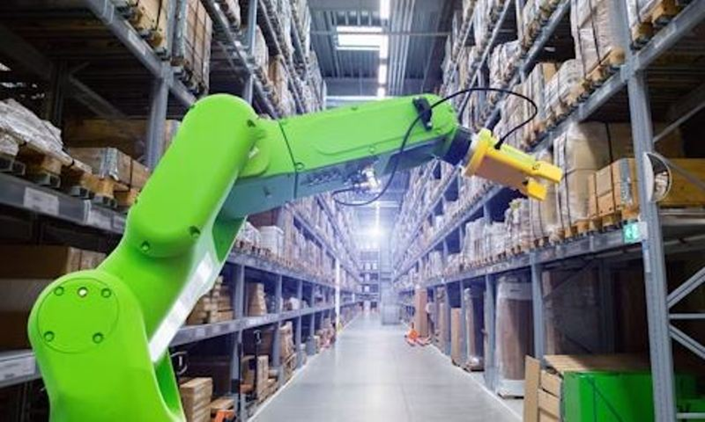
The company’s automation portfolio includes autonomous
mobile robots, sorting robots, Automated Storage and Retrieval Systems (ASRS),
and robotic picking solutions. It is now expanding aggressively into advanced
robotics, including collaborative robots, quadrupeds for industrial
surveillance and defence applications, and humanoid robots. Kumar noted that Addverb launched Elixis-W,
India’s first indigenously developed wheeled humanoid robot for industrial
applications, at LogiMAT India earlier this year, while a legged humanoid
version is currently under development and training ahead of its commercial
launch. Addverb has also diversified
its business beyond its traditional retail and e-commerce customer base. While
the segment once contributed nearly 90-95% of revenue, it now accounts for
around 30%, with consumer goods, chemicals, petrochemicals, renewable energy,
electronics, defence, and industrial manufacturing emerging as key growth
sectors.Highlighting India’s growing
opportunity in advanced manufacturing, Kumar said rising investments in solar
module production, battery manufacturing, and industrial electronics are
driving significant demand for robotics and automation solutions. Looking ahead, Addverb plans to raise fresh
capital to accelerate its expansion into next-generation robotics and
strengthen its global footprint.
“We want to be
among the top five robotics companies in the world in the next 10 years. That
cannot happen by serving only the domestic market. We have to build a truly
multinational company,” Kumar said, adding that although Addverb remains a
relatively young company, it has reached an inflection point and is well-positioned
to compete with established global automation leaders.
Related News