


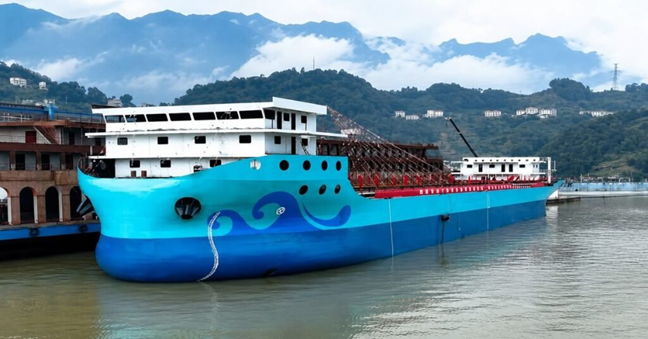
MV Yampu, World’s First Battery Powered Self Unloading Bulk Carrier, Enters Commercial Operation in Australia
The 125-metre vessel officially began service out of South Australia,
carrying limestone from Adbri’s Klein Point quarry to the company’s Birkenhead
cement plant in Adelaide. Built to a
purpose-designed specification, the 11,900 dwt self-unloading bulk carrier
combines hybrid propulsion with a marine battery energy storage system,
allowing peak shaving and reduced engine loading during port manoeuvring and
self-unloading sequences. The vessel was constructed at Jiangjiang Nanyang
Shipyard and delivered in June 2026 ahead of its current commercial
rollout. MV Yampu is expected to
transport approximately 2.7 million tonnes of limestone annually for Adbri,
lifting the route’s total limestone transport capacity by 35 percent compared
to the vessel it replaces, MV Accolade II.
Compared to its
predecessor, the new vessel is projected to cut diesel consumption by roughly
half a million litres of fuel and reduce Scope 1 emissions by 40 percent. CSL
and Adbri have set a longer-term pathway toward fully electric, zero-emission
operation for the vessel, targeting more than 90 percent emissions reduction by
2031. MV Yampu offers an early proof of concept for battery hybrid systems in
a heavy-duty cargo segment that has lagged behind container and tanker shipping
on electrification. As CSL positions itself as the world’s largest owner and
operator of self-unloading ships, the vessel’s entry into service signals
growing confidence in battery hybrid retrofits and newbuilds as a practical
decarbonisation route for short-sea and coastal bulk trades. Adbri described the vessel as more than a
new ship entering service, framing it as an investment in the future of South
Australian manufacturing and lower-carbon cement production, while supporting
local supply chains and jobs across the region.

Related News