



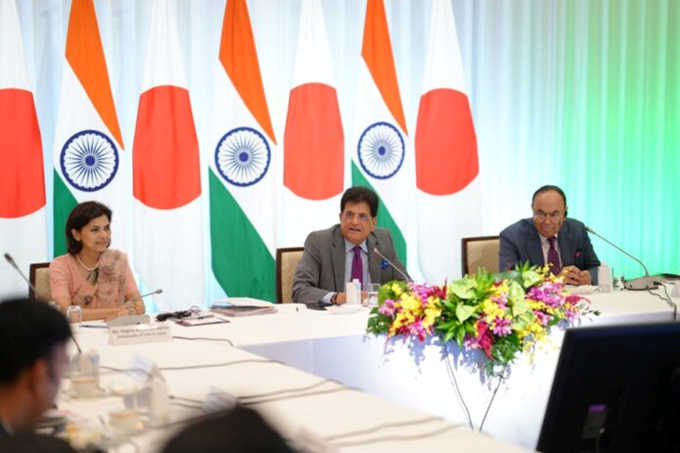
Piyush Goyal highlights India’s growing Startup Ecosystem at India–Japan Startup Roundtable in Tokyo
He said India’s large domestic market, deep
STEM talent pool, digital public infrastructure and rapidly expanding
innovation ecosystem make it an attractive destination for Japanese technology,
investment and innovation partnerships.
The Roundtable brought together senior government representatives,
investors, industry leaders and startups from both countries, reaffirming the
shared commitment of India and Japan to deepen cooperation in startups, deep
technology, innovation and MSMEs. Discussions focused on strengthening
technology partnerships, promoting investment and fostering the next phase of
innovation-led economic collaboration between the two countries. Welcoming the participants, Ambassador Nagma Mohamed Mallick
highlighted the growing startup engagement between the two countries. The
India–Japan Pitching Series has already connected 65 Indian startups with
around 100 Japanese corporations and facilitated more than 30 business tie-ups.
She noted that the participation of a 222-member Indian business delegation
provides an opportunity to forge new and enduring partnerships between the two
innovation ecosystems. Shri Goyal proposed a forward-looking framework for
the next phase of India–Japan startup cooperation centred on four pillars: a
Japan–India Deep-Tech Capital Corridor to mobilise patient capital for
early-stage research, deep-tech innovation and commercialisation; a Two-Way
Innovation Bridge connecting universities, incubators, R&D institutions,
laboratories and testing facilities in both countries; Manufacturing and
Technology Integration, combining India’s scale, engineering talent and
entrepreneurial dynamism with Japan’s precision engineering, technology and
manufacturing capabilities; and Joint Startup Pitching Platforms to facilitate
regular interactions between Indian founders, Japanese corporations, venture
funds and strategic investors. The Minister also highlighted the
Government of India’s proposed second Fund of Funds of around US$1 billion,
with a focus on supporting deep-tech enterprises, and invited greater
participation from Japanese investors.
Japanese stakeholders welcomed the growing maturity of India’s startup
ecosystem. JICA Senior Vice President Shohei Hara emphasised the importance of
a two-way partnership, noting that Japan can contribute its technological
capabilities while learning from India’s ability to convert social and
developmental challenges into scalable business opportunities. JICA also
expressed its intention to showcase opportunities in the Indian market to a
larger number of Japanese startups. The
Roundtable saw participation from senior leadership of the Tokyo Metropolitan
Government and JETRO, which partnered with the Mission in bringing Japanese
companies to the session. Representatives of around 40 leading Japanese
companies, including SPARX Group, MUFG Innovation Partners, Beyond Next
Ventures Inc., Incubate Fund Asia, Mizuho Financial Group, SBI Investment,
Fujitsu Limited, DG Daiwa Ventures, ASTRO GATE Inc., Incubate Fund, Instalimb
Inc., Universal Materials Incubator Co., Ltd., Kyoto Fusioneering Ltd. and
Aerosense Inc., also participated in the discussions. Startups from various
sectors, Indian business chambers and members of the Indian business delegation
were also present. Industry
representatives stressed the importance of integrating MSMEs with startups and
global supply chains and providing plug-and-play infrastructure to companies
seeking to manufacture and expand in India.
Venture capital investors
identified AI, semiconductors, healthcare, space, defence, advanced
manufacturing and deep technology as major areas for future India–Japan
investment. Investors also noted the visible transition of India’s startup
ecosystem from predominantly internet and software businesses towards
manufacturing- and technology-intensive enterprises. Indian startups showcased
capabilities across aerospace and defence, drones, artificial intelligence,
healthcare, prosthetics, robotics, warehouse automation, mobility and digital
health. Several companies explored Japanese partnerships for technology
validation, precision manufacturing, investment, market access and integration
into Japanese and global supply chains.
The Roundtable recognised the
highly complementary strengths of India and Japan. India offers scale, talent,
digital capabilities and entrepreneurial speed, while Japan brings patient
capital, advanced technology, manufacturing excellence and global quality
standards. Combining these strengths can help create globally competitive
enterprises and technologies capable of serving markets in India, Japan and
third countries.
The discussions
concluded with a shared emphasis on moving from individual engagements towards
an institutionalised India–Japan startup and innovation partnership, supported
by regular investor–startup interactions, technology partnerships,
co-investment mechanisms and stronger linkages among universities, research
institutions, incubators and industries in both countries.

Related News