



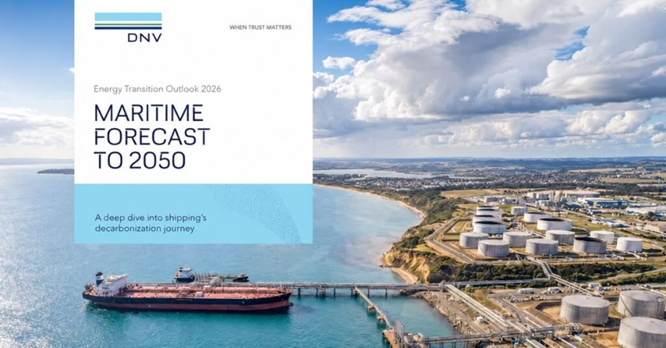
DNV Maritime Forecast to 2050: Shipowners Need Flexible Fleet Strategies amid Energy Transition Uncertainty
As ships ordered today are expected to operate well beyond 2050, DNV
highlights the need for decisions that balance near-term compliance
requirements with the long-term flexibility needed to respond to changing
regulations, fuel markets and technologies.
While global alignment at the International Maritime Organization (IMO)
remains uncertain, regional regulation is already influencing decisions on fuel
use, operations and investment. DNV’s report examines how different regulatory
pathways could affect fuel demand, energy-efficiency uptake and fleet
strategies. Regulation is a key
driver of maritime decarbonization, but uncertainty defines the current moment.
According to DNV, the outcome of the IMO NZF negotiations will determine the
pace of the energy transition, shaping future demand for low-GHG fuels and the
scale of energy-efficiency uptake in the years ahead. The report presents four regulatory
scenarios ranging from NZF adoption to prolonged gridlock. These scenarios reflect the uncertainty
surrounding future policy outcomes and illustrate how different regulatory
pathways could influence fuel uptake and energy-efficiency deployment. Energy
efficiency can deliver fuel and emissions reductions across all scenarios while
helping shipowners manage rising fuel costs. DNV says stronger global
regulatory signals could accelerate the uptake of energy-efficiency measures,
enabling the global fleet to consume up to 25% less energy by 2050 compared
with a scenario where regulation is driven by regions. This can be achieved through fleet renewal,
operational improvements and retrofits. A case study of a hydrodynamic measures
retrofit on a 5,000 TEU container vessel showed potential annual fuel savings
of 16%, with a payback time of around one to four years depending on future
fuel prices. DNV highlights that the transition to
low-GHG fuels will depend on stronger regulation-driven demand signals and
continued investment in fuel production.
Depending on regulatory outcomes, shipping’s demand for low-GHG fuels
could range from 4 to 22 Mtoe by 2030 and 33 to 185 Mtoe by 2050. As demand
grows across shipping and other sectors, competition for fuels and feedstocks
is expected to increase, placing pressure on fuel availability and costs. Based on current project pipelines, a
maximum of 270 Mtoe of low-GHG fuel supply could materialize by 2030. However,
DNV notes that the actual volume is likely to be significantly lower due to
project delays, cancellations and other uncertainties. With regulatory pathways, fuel
availability and technology development still evolving, DNV’s scenario-based
approach is designed to help shipowners evaluate fleet strategies across
multiple possible futures. The
report provides a framework for balancing cost, risk and flexibility, helping
stakeholders assess how different combinations of fleet renewal, energy
efficiency and fuel strategies could perform as the maritime energy transition
develops.
Related News