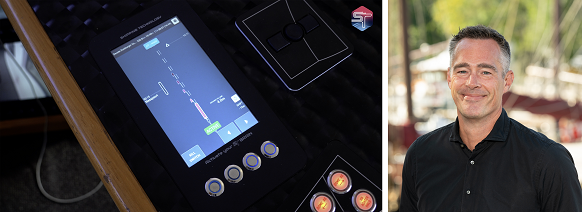
Shipping Technology launches ST Sailing Pro, adding automatic propulsion control to conventionally powered inland vessels
Shipping Technology has launched ST Sailing Pro, an extension of its ST Sailing track pilot that now not only controls a vessel's steering, but also its propulsion. This is the next, planned step in the company’s roadmap towards autonomous sailing. In short: the captain enters a destination and a desired arrival time, after which the system continuously calculates the course and engine power needed to meet it – taking changes in locks, currents, water levels etc. into account. On a normal sailing pattern, ST Sailing Pro reduces fuel consumption by a further 10 per cent on top of the 5 per cent already validated for ST Sailing. The system operates at level 2 of the CCR automation scale, with the captain supervising at all times.
Shipping Technology started collecting vessel data in 2018, with the ST Brain PRO onboard unit and added automatic rudder control five years ago, and now running on 400+ vessels. ST Sailing runs on some 200 vessels and has logged more than 315,000 sailing hours and 4.4 million kilometres. That data set has significantly speeded up developing the next step: active propulsion control.
Trials last year used a thruster-driven river cruise vessel and covered automated manoeuvring. Testing then moved to conventionally equipped commercial vessels - main engines, reverse-reduction gearboxes, a propeller shaft and a rudder - which make up the largest part of the inland fleet. After six months on a single vessel under a Smart Shipping permit, trials now run across several vessels in the dry cargo, tanker and passenger shipping markets.
Related News