Shipping urges Chinese vessel port fee delay as Trump-Xi summit begins
In a joint letter on 23 September to US Trade
Representative (USTR) Jamieson Greer, over 200 importers, exporters, and
transportation groups – including the International Chamber of Shipping, the
World Shipping Council, and the Chamber of Shipping of America – urged the
administration to delay the fees before the current one-year suspension expires
on 9 November. “Because China-built
vessels represent a meaningful share of global ocean carrier capacity, the
practical effect of the tariffs and fees would not be limited to a narrow set
of market participants,” the groups warned.
“Instead, the costs would ripple across shipping networks, affect vessel
deployment decisions, and increase uncertainty for businesses that have limited
ability to control the ownership, operation, or construction history of the
vessels used to transport their goods.”
Last year the USTR announced that effective 10 November 2025, the US
would suspend for one year the implementation of port fees on certain
Chinese-built vessels, vessels with Chinese owners or operators, and
foreign-built vehicle carriers calling at US ports. The Transport Ministry of
China had likewise declared that China would suspend its own retaliatory port
fees against the US for one year.
Unless USTR publishes a further extension, the maritime fees imposed by
the US against China will come back into force. It is expected that in such a
scenario the retaliatory Chinese port fees against US linked shipping would
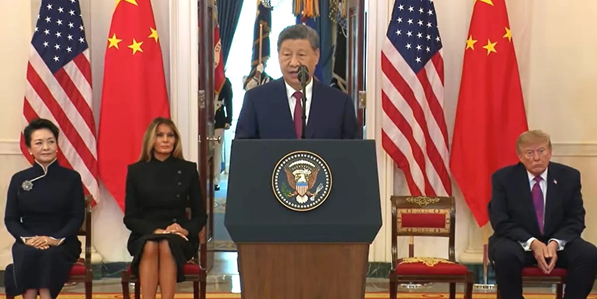
also be reinstated. Neither Trump nor
Xi mentioned specifically the maritime fees during their opening public
statements at the White House summit on Thursday (24 Sep) morning, focusing
instead on mutual cooperation between the two superpowers. “The interests of China and the United
States are deeply intertwined, and there is plenty of room for us to work
together,” Xi said in his remarks alongside Trump. “China-U.S. cooperation may
not solve every problem in the world, but without our cooperation, it would be
hard to solve many of the world’s problems.”
Xi added, “China keeps its door wide open, welcomes American companies
wanting to invest and do business there. We hope Chinese companies are treated
fairly here in the United States.” US
supply chains, meanwhile, continue to face mounting pressure due to broader
uncertainty in global trade lanes, the coalition emphasized in their letter to
the USTR. “Many businesses are still
working through higher costs for ocean freight, trucking, warehousing,
insurance, and inventory management,” they wrote. “These costs compound quickly
and are ultimately borne by U.S. businesses, workers, farmers, and consumers.”

Related News