


PiyushGoyal invites Japanese businesses to deepen investments and partnerships in India
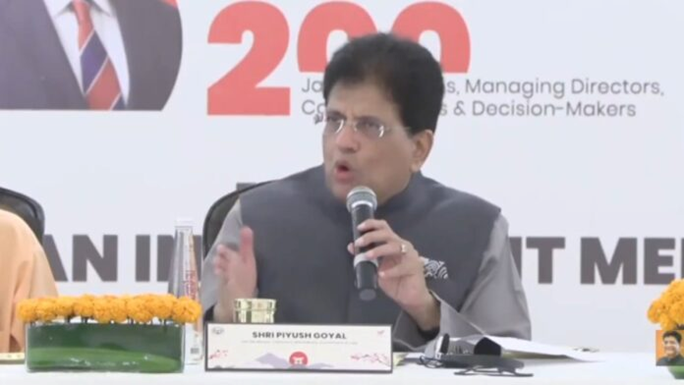
Addressing the
gathering, Shri Goyal said that India and Japan share a close and enduring
partnership rooted in common aspirations for peace, progress and prosperity in
the Indo-Pacific. He noted that the presence of the delegation from Yamanashi
Prefecture reflects the growing reach of the bilateral partnership into India’s
States and regions. Shri Goyal said
that the seven streams of national transformation outlined by Prime Minister Shri Narendra Modi—manufacturing,
agriculture, technology, infrastructure, energy and defence, green and blue
economy, and India’s civilisational soft power—represent areas where the
strengths of India and Japan complement each other. He said the partnership
goes beyond economic growth and reflects a shared commitment to becoming
trusted partners in global progress.
Highlighting Uttar Pradesh’s growing economic potential, Shri Goyal said
the State, under the leadership of Chief Minister Shri Yogi Adityanath, is
working towards its ambition of becoming a USD 1 trillion economy. He said
Uttar Pradesh’s large and aspirational population, improving connectivity,
industrial momentum and skilled workforce provide a strong platform for
Japanese technology and expertise to complement India’s young workforce and
expanding market. Referring to the 16th
India-Japan Annual Summit held in Delhi in July 2026, Shri Goyal highlighted
the strategic ambition underpinning the relationship, including Japan’s target
of investing 10 trillion yen in India over the next decade. He said investments
in areas such as artificial intelligence, semiconductors, critical minerals,
batteries, energy and next-generation mobility would play an important role in
shaping the future of both economies.
Shri Goyal said the growing India-Japan partnership is already
visible on the ground, citing the Mumbai-Ahmedabad High-Speed Rail project,
Japanese-assisted metro systems in Delhi, Ahmedabad, Bengaluru and Chennai, and
11 Japanese industrial townships across eight States. He noted that more than
1,400 Japanese companies are today operating in India, with household names
such as Suzuki, Toyota and Honda in mobility, Sony in electronics, and Hitachi
and Mitsubishi in engineering. He said bilateral trade stood at around USD 27.5
billion in FY 2025-26, while Japan is now India’s fifth-largest source of FDI,
reflecting the strong foundation for further expansion of economic ties.
Drawing on the Japanese
philosophy of ‘Kaizen’, Shri Goyal said India’s reform journey reflects a
similar spirit of continuous improvement. He highlighted reforms in ease of
doing business, infrastructure, digital
public infrastructure, multimodal logistics and expanding Japanese language
capabilities as part of India’s efforts to create a more enabling environment
for investment and growth. Shri Goyal said Uttar Pradesh, India’s third-largest
State economy, has more than 9 million MSMEs and is the fifth-largest State
exporter. He noted that enterprises such as Escorts Kubota and Seiko Advance
are already contributing to the State’s manufacturing ecosystem. He further highlighted the Jewar International Airport, Yamuna
Expressway and the JICA-supported Western Dedicated Freight Corridor, along
with 27 industrial clusters and ecosystems in sectors including defence,
semiconductors and electronics, as key strengths that position Uttar Pradesh as
a promising destination for deeper Japanese partnerships.
Shri Goyal said he would be
visiting Japan from 24 to 27 August 2026 to take forward these conversations at
the highest levels of government and industry and further strengthen the
Special Strategic and Global Partnership between India and Japan. Emphasising the civilisational ties between
the two countries, Shri Goyal recalled the historical connection between India
and Japan through the teachings of Buddha. He invited Japanese businesses to
make India, and Uttar Pradesh in particular, a centre of their growth and a hub
for Japanese innovation serving the Indo-Pacific and the world.
Related News