KR, HD Hyundai Heavy Industries, BAR Technologies and Liberian Registry Join Forces on Wind-Assisted LNG Carrier
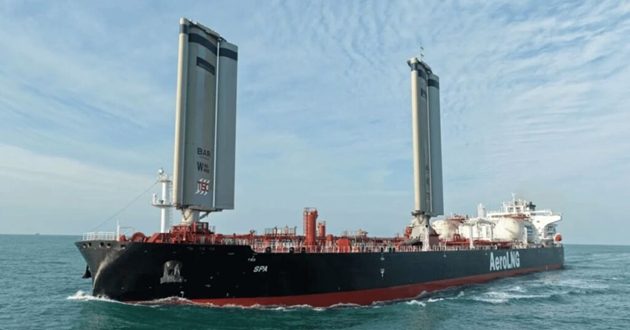
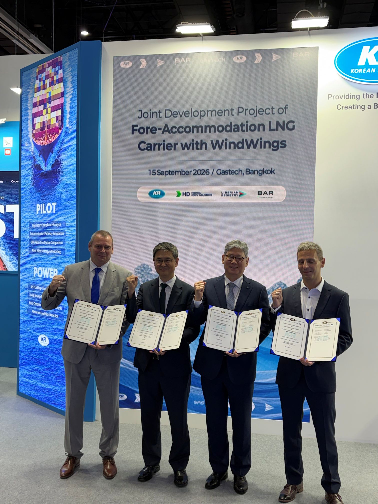
Korean Register (KR) has signed a Memorandum of Understanding (MoU) with HD Hyundai Heavy Industries (HD HHI), UK-based wind propulsion technology company BAR Technologies, and the Liberian International Ship & Corporate Registry (LISCR) to jointly develop a 174K LNG carrier equipped with the WindWings® wind-assisted propulsion system.
The agreement was signed on 15 September at Gastech 2026 in Bangkok and aims to assess the technical feasibility and safety of applying wind-assisted propulsion technology to LNG carriers as the global shipping industry accelerates its transition toward decarbonization.
The project will focus on a 174K LNG carrier developed by HD HHI featuring a forward accommodation arrangement. By positioning the crew accommodation block toward the bow, the design provides additional space on the upper deck, creating an opportunity to integrate BAR Technologies’ WindWings system.
WindWings® uses large, rigid wing sails installed on a vessel to harness wind as supplementary propulsion. By reducing reliance on the vessel’s main propulsion system, the technology can lower fuel consumption and greenhouse gas emissions while improving overall energy efficiency.
Under the collaboration, HD HHI will lead the vessel’s basic design and design review, while BAR Technologies will provide technical data covering the arrangement and specifications of WindWings, structural strength, operational concepts and expected fuel savings.
KR, together with LISCR, will assess the safety and technical suitability of the design against applicable rules and international requirements. Based on the outcome of the assessment, KR will also consider granting Approval in Principle (AIP), supporting the application and future commercialization of wind-assisted propulsion technology on LNG carriers.
Hongryeul Ryu, Chief Technology Officer of HD HHI, said: “We have continued to develop innovative hull forms and arrangement concepts for LNG carriers to advance environmentally friendly ship technologies. Through this project, we aim to integrate wind-assisted propulsion technology into our forward accommodation LNG carrier design, further enhancing the competitiveness of next-generation, low-emission LNG carriers.”
Related News