India and Egypt to explore trade pact as Cairo talks focus on ports and manufacturing/
The Joint Trade Committee has
been elevated to ministerial level. Its Cairo agenda included non-tariff
barriers, trade remedies and customs cooperation, alongside trade in food
products, pharmaceuticals, engineering goods, chemicals, fertilisers and
textiles. Goyal also said the two sides would explore mutual recognition
arrangements between testing agencies, which could help exporters meet product
requirements in each other’s markets.
The decision in Cairo starts an assessment of the scope and feasibility
of a trade pact. The terms of reference will guide that work. Tariff and market
access commitments would depend on the outcome of any subsequent
negotiations. India’s Commerce Ministry
identified the Suez Canal Economic Zone as a potential area for cooperation in
industrial development, manufacturing, infrastructure, ports and logistics. The
zone comprises four industrial areas and six ports, including Ain Sokhna and
East Port Said. Its location along the canal gives manufacturers access to
maritime routes serving markets in Africa, the Middle East and Europe.
Renewable energy and green hydrogen were also on the trade committee’s
agenda. More than 130 business leaders
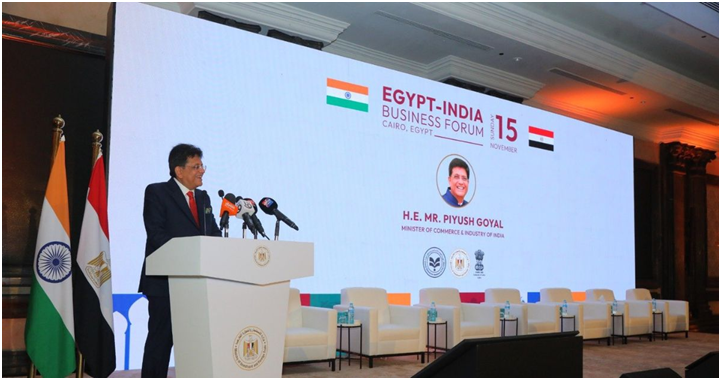
and start-up representatives accompanied Goyal on the visit. The programme
included the India–Egypt Joint Business Council, a business forum and meetings
with the African Export-Import Bank (Afreximbank). The business sessions were
intended to bring companies together to discuss joint ventures, investment and
technology partnerships. Goyal said nearly 70 Indian companies already operate
in Egypt, with investments exceeding US$5 billion. Bilateral goods trade reached US$5.04
billion in April–September 2026, up 64% from the same period a year earlier, according
to India’s Commerce Ministry. For the full 2025–26 financial year, India
exported US$3.87 billion of goods to Egypt and imported US$2.60 billion,
putting two-way merchandise trade at US$6.47 billion.
India’s main exports to Egypt
include petroleum products, organic chemicals, machinery, cotton, and meat and
poultry products. Its principal imports include crude petroleum, fertilisers,
cotton and mineral products. The Cairo talks covered ways to broaden that mix,
with manufacturing and logistics among the areas identified for further
cooperation.
Related News