


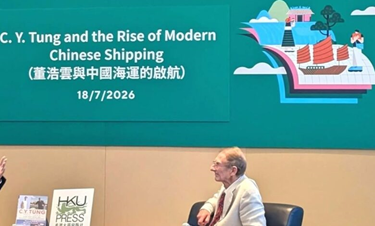
C. Y. Tung and the Rise of Modern Chinese Shipping
For maritime historian
Professor Howard Dick and co-author Stephen Kentwell, however, the story of
legendary Hong Kong shipowner C. Y. Tung became a lifelong project stretching
from an encounter with one of his early containerships in 1970 to the launch of
their biography in Hong Kong this month.
The finished work, C. Y. Tung (1912–1982) and the Rise of Modern Chinese
Shipping, is more than the life of one tycoon. It charts the emergence of
Chinese deepsea shipping from a marginal position beneath the established
European, American and Japanese lines to a force capable of competing across
every major maritime sector.
Tung’s career spans an
extraordinary period: Republican China, the Japanese invasion, World War II,
civil war, the emergence of Hong Kong as an industrial and shipping centre, the
arrival of containerisation and the relentless decline of many of the western
lines that once dominated Asian trade. Tung began his working life as a junior
shipping executive in the early 1930s, when Chinese shipowners operated at a
considerable disadvantage in their own country. As secretary of the Tientsin Shipowners
Association, the young Tung proposed a new national shipping policy designed to
address the treaty privileges enjoyed by foreign operators and the absence of
effective cabotage protection for Chinese companies. Dick argues that Tung was already
thinking like a revolutionary. His
ambition was not simply to accumulate ships. It was to create a Chinese
merchant fleet capable of trading internationally on equal terms with the great
western shipping companies. The destruction and upheaval of the following
decade made that goal considerably harder. War
devastated Chinese shipping, while the political and commercial map of the
country was transformed. Tung
nevertheless emerged from the conflict determined to establish a deepsea
presence. Through China Union Lines, he sought to build a Chinese liner
capability, while developing his own private tramp fleet alongside it. In 1947, one of his ships, operated with an
all-Chinese crew, reached the Atlantic coasts of the US and Europe. The voyage
was an important symbolic achievement for a man who believed Chinese-owned and
Chinese-operated ships should be visible in every major trading region.
After the communist victory in 1949, Hong Kong
became the base from which Tung built his international empire.
The colony offered access to finance, cargo,
professional services and the trading networks connecting China, Taiwan, Japan,
Southeast Asia, Europe and North America.
Tung was well
positioned to benefit. As Hong Kong and East Asia industrialised, the region
generated the cargo volumes needed to support increasingly frequent and
sophisticated shipping services. In 1957, he became the first Hong Kong or
Chinese owner to order a new bulk carrier. Tankers followed, along with liner
ships, passenger vessels and eventually the largest ship ever built. His businesses expanded beyond ships into
terminals, dockyards, banks and property. By the end of his life, the Tung
fleet comprised more than 150 vessels totalling around 11m dwt. Dick nevertheless presents Tung not merely
as an asset collector, but as an owner willing to enter new sectors before
their commercial potential is fully understood.
“Though Y K Pao owned the larger fleet, over the
period 1948 to 1982 C. Y. did more across the several sectors to place Chinese
deepsea shipping on parity with US and European shipping,” he says.
That willingness to make audacious bets is perhaps
best captured by Tung’s purchase of Cunard’s former flagship Queen Elizabeth.
Tung planned to
convert what had been the world’s largest passenger liner into Seawise
University, a floating campus that would carry students around the world. The ship caught fire during conversion in
Hong Kong in 1972 and sank in Victoria Harbour. The project became one of the
most visible setbacks of Tung’s career, but also illustrated the scale of his
imagination and his enthusiasm for education.
He later supported another shipboard education programme rather than
abandoning the concept entirely.
At the opposite end of the shipping spectrum comes
the 564,763 dwt Seawise Giant. The ultra-large
crude carrier was the biggest ship ever constructed, its name playing on Tung’s
initials.
Yet Dick argues Tung’s most enduring maritime
achievement is not his ownership of record-breaking ships. It is his early
embrace of containerisation...His
success, Dick says, rests on careful attention to costs, guaranteed frequency
and reliability, intensive international networking and the cultivation of
corporate culture and morale. Tung
operated across political divides during the Cold War, maintaining the
relationships needed to secure finance, ships and cargo in a world where
Chinese commerce remained deeply entangled with the rivalry between Beijing and
Taipei. “He was able to learn, innovate
and network,” Dick says. “He understood that shipping was not just about owning
vessels. It was about having cargo, relationships and dependable services...For
Dick and Kentwell, the route to documenting this career began with ships rather
than biography. Their early fleet research led to correspondence with C. H.
Tung’s office and later with Tung’s daughter Alice King, who spent years
collating and editing her father’s diaries and papers. Kentwell met King in Shanghai in 2002.
Both authors met her again in Hong Kong in 2010, when she invited them to write
a scholarly biography of her father for a western readership as part of
celebrations marking the centenary of his birth in 2012. The manuscript was
completed, but health issues prevented its publication at the time.
More than a decade
later, the third generation of the Tung family rediscovered the work and pushed
for the project to be revived. Hong Kong University Press took it on, leading
to further revision, updating, peer review and editing before its launch this
month at the Hong Kong Book Fair and Hong Kong Maritime Museum. The business
inherited by that third generation is now very different. Following the sale of OOCL, the Tung group
is considerably smaller and entirely private and family-owned. Through Island Navigation, it remains a
significant niche participant in the product tanker market, pursuing what Dick
describes as a conservative investment strategy focused on long-term
sustainability. “The circumstances for relentless accumulation no longer
exist,” he says.
The group may no
longer possess the scale or public profile it enjoyed under C. Y. Tung. Its
influence, however, can still be seen in the global standing of Chinese
shipping.
Related News